
The academic world can be quite a jungle to hike through, especially if you are the first in your family to pursue a degree. Have you ever felt like you needed some support during your higher education journey?
The idea to start Project FirstGen Philippines did not come out of nowhere: I was a first-generation student myself when I started studying. None of my parents had academic experiences, none of my extended family either. This might have been quite some time ago but I still remember clearly how intimidating the entire higher education journey was throughout my bachelor and master degrees. I just jumped onto campus, joined some introduction events and had the chance to meet other students for the first time. And there it was: the suspicion that most of the people I’ve met on campus came from very different backgrounds than me.
Obviously, being as young as I was, my initial thought was that something was wrong with myself. I must have missed out during high school. Maybe I didn’t prepare enough before starting to university? How else could it be that most of the people I met during my first weeks, almost naturally, understood the way university life was flowing? They seemed like they waited for the time to finally study and experience a life they have already heard and dreamed about. They seemed energized, motivated, and curios. Meanwhile, I was busy understanding the difference between an essay and a research paper. Deep down I already felt like don’t belong there.
Of course, at that time this wasn’t clear to me. I thought that, obviously, everybody would feel insecure about studying. It’s just normal to be overwhelmed by the unknown. We are all faking it! To some degree, there is probably some truth in there. But how can it be then, that first-generation students fall behind in almost all metrics when it comes to university performance?
In Germany, my home country, the academic experience of students’ parents is still the number one determining factor if their child will have a successful higher education journey (or not). Not even speaking of them successfully graduating, they already enroll in far lesser numbers. Of 100 children that have at least one academic parent, 79 enroll in bachelor programs. 43 of them will later on finish their master degree. Of 100 children without academic parents, only 27 start studying. Of those, barely 11 will become master graduates. The differences are dramatic, without a doubt.
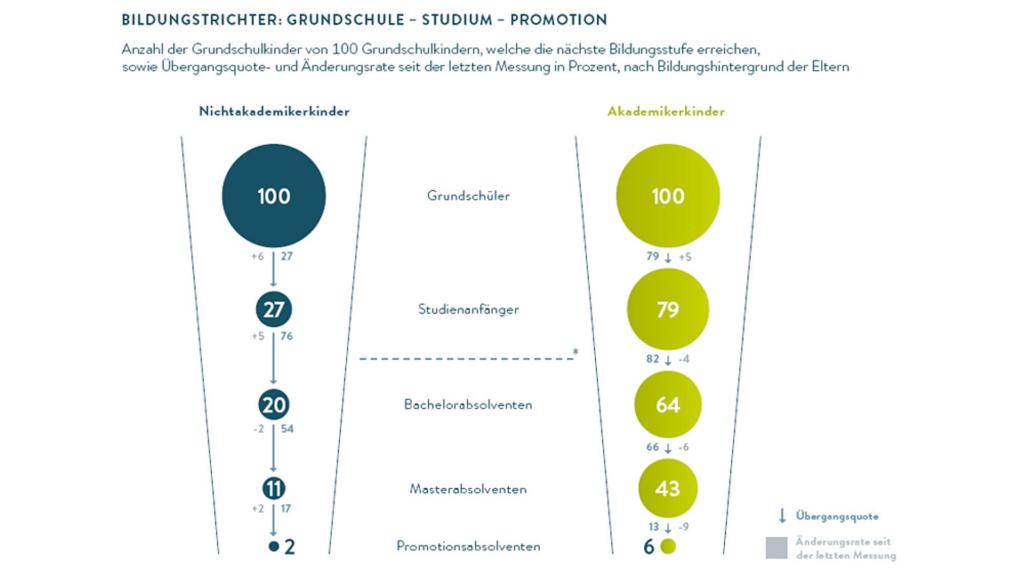
Higher education access of first-gen (left) and continuing-gen students (right) in Germany
There are others factors at play, too, like the student’s gender, migration background, if they have urban or rural origins and many more. Those factors cannot be seen as individual pillars, though. In the end, being a first-generation student (or not) is a common thread that has an impact across those lines. As a side note: you might wonder why I refer to the German context here. To cut it short, universities in the Philippines barely collect any data about first-generation students. If you have access to research, let me know!
One might say now, that its all about money. Academic parents are more likely to earn more than their non-academic counter parts and university costs money. Obviously, children of the latter are then less likely to afford expensive degrees. And sure, this is definitely a factor that should not be ignored. However, higher education in Germany is basically “free”. I am careful with this word because pursuing a degree still comes with financial burdens, let alone living in expensive cities where universities are usually located. Regardless, attending a German college generally comes with lower semester fees than Ateneo or La Salle. Also, you have the opportunity to receive financial support from the German state.
All together: pursuing a degree comes with financial burdens, yes, but there must be other reasons, too, for the lack of first-generation access to higher education. Even if all universities in the Philippines would be free of any costs, those students would still be disadvantaged. Why is that?
For the sake of not making this first post dramatically long, I want to come back to my initial experience. When I was in university, there was this constant creeping feeling that something is off. It was nothing conscious, nothing I could fully grasp at that point but deep down it became clear to me that I struggled integrating myself into an environment that was not created and maintained by people “like me”. It was a jungle of new words I couldn’t understand, new formats of learning I was not familiar with and a complete lack of an internal compass that others seemed to be able to rely on. I felt like I was watching a movie from the outside, while other students had the chance to play a part in it.
There was a huge cultural mismatch between me and the university environment, a glass ceiling that was looming beneath every lecture I visited, every group work I was part of. Sure, there were definitely financial differences between me and other students, too, but the social context had the biggest impact on me. On top of that, I didn’t have the opportunity to reflect on those experiences within my family, either.
Of course, university is all about learning and growing but how could I even achieve that without knowing how to learn and grow? How could I play my part in that movie like all the others, if I had no idea how and where to even ask for support and guidance? And, ultimately, how could I be able to reflect on this entire experience without even knowing that being a first-generation student is “a thing” and that this “thing” determined so much of my educational journey?
If you have read this post until now and might have found yourself asking yourself those same questions: Project FirstGen Philippines was created for you. I am convinced that first-generation students are not naturally meant to struggle at universities. As a matter of fact, I believe that universities would benefit immensely by shaping themselves more towards them, given that there thousands of them everyday on Filipino university campuses.
Until this becomes more and more a reality, Project FirstGen Philippines is meant to provide a nourishing and supportive environment for all first-generation students in the Philippines. It might only start with this little blog, but believe me, there is more to come. Until then, I hope this post made you curious about this topic, even if you are not a first-generation student yourself. If you are one, though, I would love to hear from you!
Timo
Text references:
Image references:
https://www.pexels.com/@cottonbro/
https://hochschulbildungsreport.de/fokusthemen/arbeiterkinder


 Project FirstGen Philippines
Leave a comment